RAGA: Real Time Ray Traced Gaussian Shadow Casting for 3DGS Avatar–Scene Interaction

ECCV 2026
1Tübingen AI Center, University of Tübingen   2MPI for Informatics, Saarland Informatics Campus   3Imperial College London   4KAUST   5Snap Inc.
* Work done in part during an internship at Snap Inc.
~50 FPS
Real-Time Rendering
No Mesh
Fully in Gaussian Space
Exact
Ray–Gaussian Integrals

Animated avatars casting physically plausible shadows in a 3DGS scene — entirely in Gaussian space, no mesh reconstruction.

Abstract

We study the problem of physically plausible shadow casting when animating 3D Gaussian Splatting (3DGS) avatars, either individually or in multi-avatar and object-interaction scenarios, within existing 3DGS scenes. In contrast to prior methods that rely on binary hit tests and mesh-based shadow casters, our method performs shadow computation entirely in Gaussian space, without requiring any mesh reconstruction.

Avatar–Object Interaction

Avatars interacting with objects — both casting shadows coherently in Gaussian space.

Single Avatar

Single animated avatar casting physically plausible shadows in diverse 3DGS scenes.

Method Overview

RAGA method overview — ray-Gaussian intersection strategies

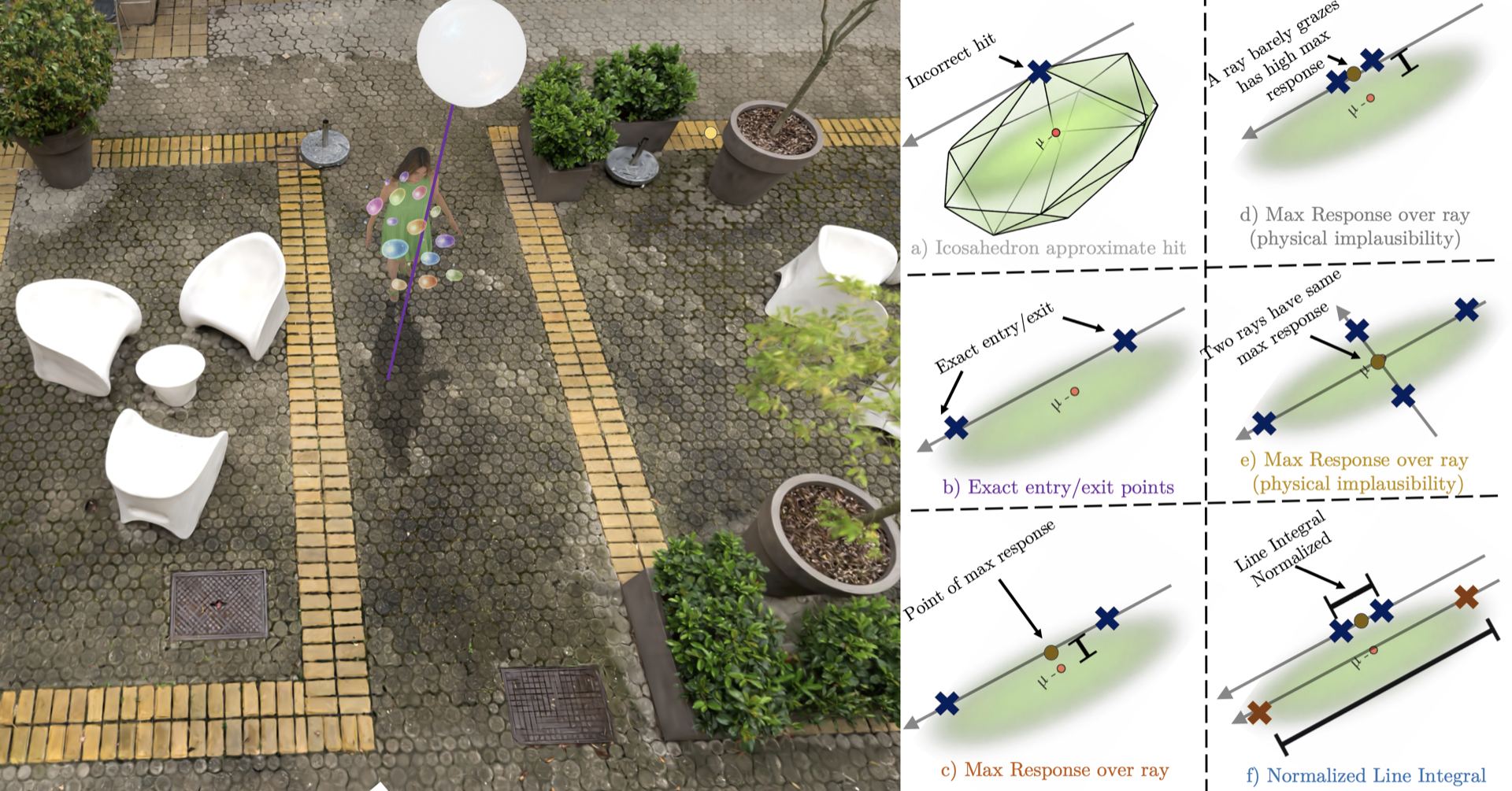
Method overview. Left: a shadow ray is cast from a scene Gaussian toward the light source through an animated 3DGS avatar by accumulating ray transmittance over all Gaussians in the avatar. Right: comparison of ray–Gaussian intersection strategies. (a) The icosahedron proxy used by 3DGRT produces incorrect hits outside the Gaussian support (this leads to blocky shadows with 3DGRT-based ray tracing because the icosahedron approximation leads to hits slightly outside the Gaussian extent). (b) Our exact quadratic test finds precise entry/exit points. (c) Evaluating the maximum Gaussian response along the ray ignores traversal depth. (d) The point of maximum response does not reflect total volumetric obstruction. (e) Two rays with different traversals receive the same max response, and a grazing ray is overweighted. (f) Our normalized line integral correctly captures how much of each Gaussian the ray traverses.

Comparison

RaySplat (Mod)
3DGRT (Mod)
Ours

Due to the icosahedron approximation of 3DGRT, rays which don’t actually fully hit a Gaussian are classified as hits—this leads to more of the human surface being considered as occluders, which produces blocky shadows. While RaySplat uses exact entry and exit points, it does not model how a ray traverses a Gaussian—i.e., it ascribes equal weight to rays irrespective of how they traverse a Gaussian, provided they pass through the same point. Our model, based on line integrals, addresses this by correctly capturing the volumetric obstruction along each ray.

Why Not Mesh-Based Shadow Casting?

Scene mesh extraction is lossy. Obtaining a high-quality mesh from a 3DGS scene is not straightforward and leads to significant loss of detail. While a floor proxy can be used for evaluation, this discards all wall- and furniture-based shadow receivers.

Mesh proxies lose detail. Mesh-based shadow casting requires replacing occluders with mesh proxies such as SMPL for humans, which discards clothing and hair detail from the shadow silhouette. Our avatar proxy retains significantly more geometric fidelity because it operates on the actual Gaussian point cloud rather than a parametric body model.

No support for Gaussian objects. Mesh proxies do not generalize to arbitrary 3DGS objects inserted into scenes. Our method operates entirely in Gaussian space and naturally supports avatar–object interactions.

Acknowledgements

We gratefully acknowledge support from the hessian.AI Service Center (funded by the Federal Ministry of Research, Technology and Space, BMFTR, grant no. 16IS22091) and the hessian.AI Innovation Lab (funded by the Hessian Ministry for Digital Strategy and Innovation, grant no. S-DIW04/0013/003). We especially thank Patrick Blauth at the hessian.AI Service Center for technical assistance. This work was further supported by the German Federal Ministry of Education and Research (BMBF): Tübingen AI Center, FKZ: 01IS18039A. Gerard Pons-Moll is a member of the Machine Learning Cluster of Excellence, EXC number 2064/1 – Project number 390727645. The research reported in this publication was also supported by funding from King Abdullah University of Science and Technology (KAUST) – Center of Excellence for Generative AI, under award number 5940.


BibTeX

@inproceedings{mir2026raga,
  title     = {RAGA: Real Time Ray Traced Gaussian Shadow Casting for 3DGS Avatar-Scene Interaction},
  author    = {Mir, Aymen and Guler, Riza Alp and Wang, Jian and Wonka, Peter and Zhou, Bing and Pons-Moll, Gerard},
  booktitle = {European Conference on Computer Vision (ECCV)},
  year      = {2026}
}
Copied BibTeX to clipboard!