The body, each garment layer and long hair are separate textured meshes, with the body complete underneath.
An AI agent answers visual questions about the person and builds a matching optimization.
Avatars load into Blender, Unreal Engine and MuJoCo: cloth simulation, try-on and contact.
Occluded YouTube videos are completed into a generated 360° video of the person.

Every person needs a different optimization: the layers, their initialization and their order depend on what the person wears. AvatarAnyone lets AI agents read the structure of the person and build the optimization, and a joint optimization fits all layers.
The method in about a minute. Click a chapter to jump to it.
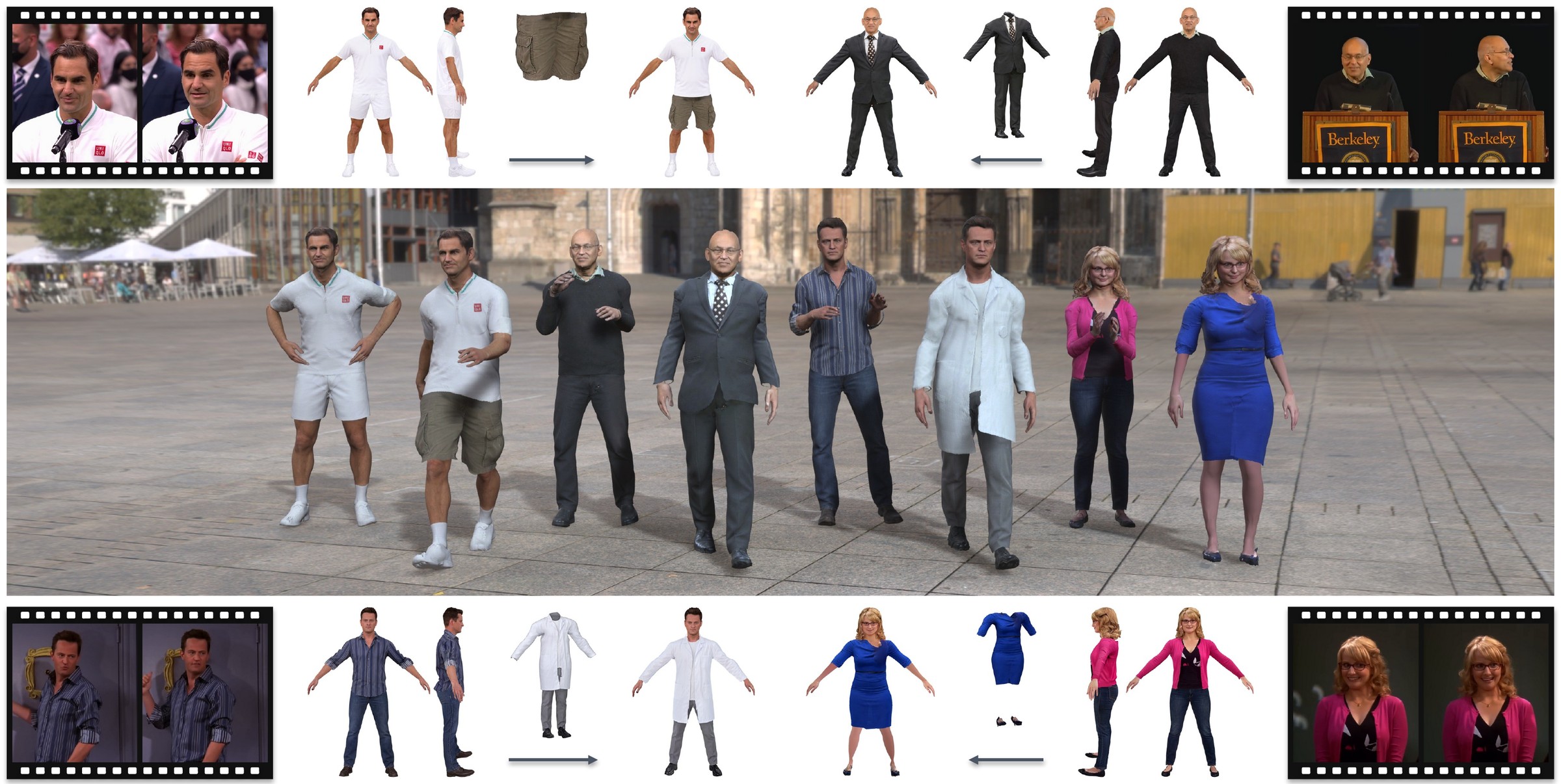
Because each garment layer is its own textured mesh with the body complete underneath, garments move between avatars. Each avatar below wears clothing reconstructed from a different video.
Try-ons in a dance pose play that dance; the others turn once in 9 s.
Each avatar's own dress or skirt is a separate garment layer, so it can be simulated as cloth over the animated body while the avatar dances: here with Blender's cloth simulator, rendered in Blender with Cycles in scenes lit by their environment maps. Five avatars, five dances.
The avatars import into Unreal Engine as skinned meshes and play motion-capture clips in game scenes. Collision bodies that follow the skeleton let Unreal's physics react to them: a thrown ball, a kicked ball, falling beach balls, crates and traffic cones.
In the robotics simulator MuJoCo, convex collision hulls built from the avatar's own mesh follow a motion-capture clip and push simulated objects: walking through a wall of boxes, capoeira among box towers, jumping jacks under falling objects, punching a spring-mounted pad, wiping cans off a table.
Layered avatars reconstructed from casual YouTube videos turn at the top of the page, each under its input clip. Each slide below shows one person: the input clip, the avatar turning once and the avatar in motion.
Reconstructions from YouTube videos with occlusions, used in our perceptual study. All six methods start from the same canonical image; we compare with three single-image human methods (PSHuman, SyncHuman, HumanNOVA) and two general image-to-3D models (TRELLIS.2, Pixal3D). Every result is rigidly aligned to ours and all six are rendered through one camera; the inset zooms on the face.
All methods start from the same canonical image, generated from this video.
3DGS avatars on the same YouTube videos. IDOL and LHM++ start from the same canonical image as ours. We pose them in the pose of our avatar, scale them to its height, and render them with the same camera and turn as the comparison above; the inset zooms on the face.
All three methods start from the same canonical image, generated from this video.
The numbers reported in the main text. All methods start from the same input image. On YouTube videos: a perceptual study against mesh-based methods and reposed renders on held-out frames. On scans: animatable avatars on 100 scans of four datasets (25 each) and static reconstruction on X-Humans.
All: the 100 scans; the appearance metrics exclude the untextured CAPE scans (CAPE: geometry only).
@article{mir2026avataranyone,
title = {{AvatarAnyone: Agentic Reconstruction of Mesh-Based Layered Avatars from YouTube Video}},
author = {Mir, Aymen and Wonka, Peter and Zafeiriou, Stefanos and G{\"u}ler, R{\i}za Alp},
journal = {arXiv preprint arXiv:2611.30777},
year = {2026}
}We are grateful to the Research Computing Service (RCS) team at Imperial College London, especially Benjamin Scharpf, for their help with computing resources.